BlogEngineering
Reverse engineering a 3D scan into parametric CAD
How to turn a 3D scan into an editable parametric model: datums, simple sketches, correcting against the scan, and proving the parameters actually work.
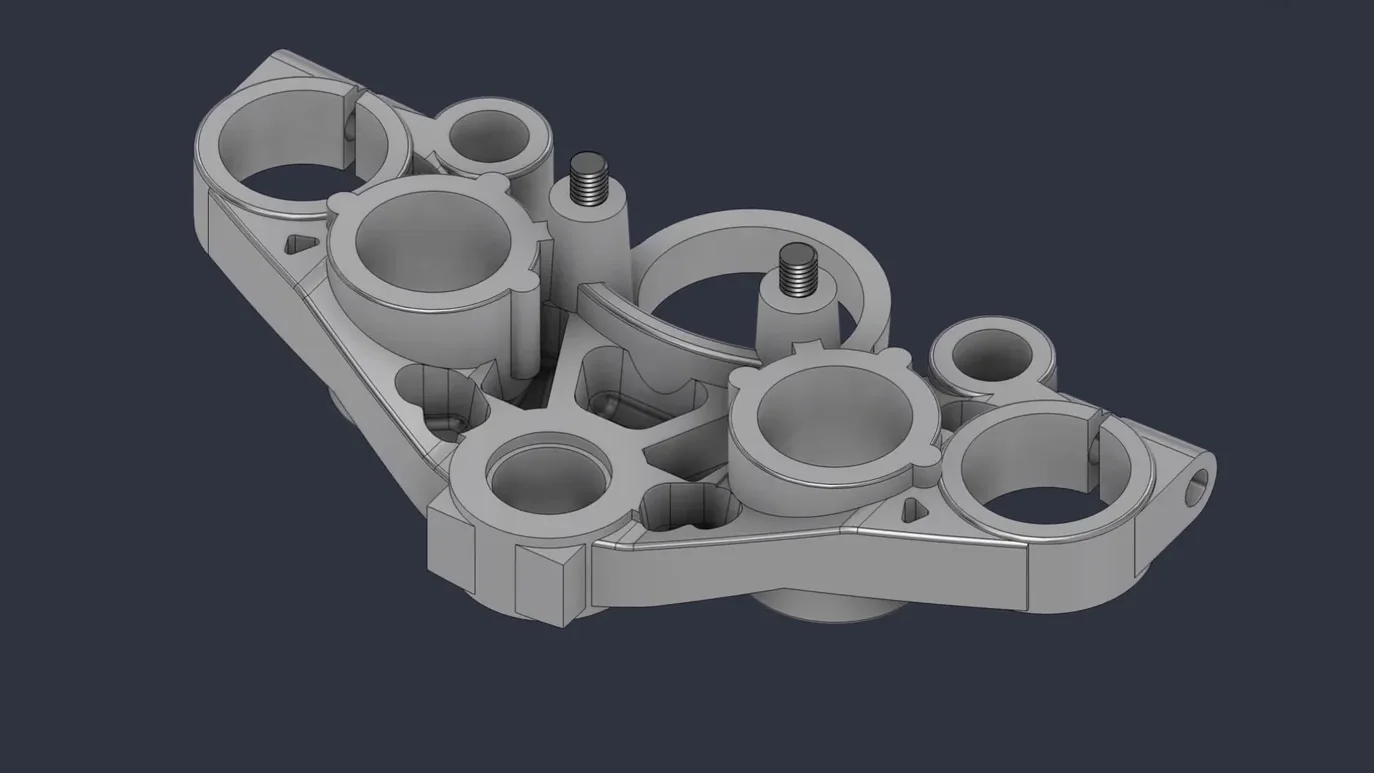
A 3D scan gives you the shape of a part but none of its intent. Reverse engineering is the work of recovering that intent: which faces are datums, which dimensions drive the rest, and which features were machined after casting.
1. Set datums from the functional features
Align the scan to the features that matter: machined bores, flat mounting faces, and the axes between them. Don’t assume symmetry the part doesn’t have. On a scanned motorcycle triple clamp, the two long bore axes differ by about 0.16°, so a single datum frame from the machined bores works better than forcing the casting symmetric.
2. Model with simple sketches
Use compact line-and-arc sketches with tangent, equal, and symmetry relations, not traced splines. Order features the way the part was made: cast pockets before machined bores, so moving a bore can’t gouge a wall.
3. Correct against the scan
Cut sections through the scan and the model and compare them. Sections reveal details a first pass misses, like a raised rib or a lobe on a sleeve. Add each one as a native feature.
4. Prove the parameters
Change the dimensions that matter and confirm the model rebuilds the way the real part would. Grow a bore by 10 percent and check that the wall around it keeps its thickness. A model that rebuilds cleanly under edits is worth far more than one that matches the scan perfectly and breaks on the first change.
A worked example
Our case study rebuilds a scanned triple clamp in 37 sketches. Bore diameter, bore spacing, and web thickness each change and restore cleanly, and the sleeve walls hold at 6.05 mm as the bores grow. Read the case study.
Questions
- Why not just convert the scan mesh to a solid?
- A converted mesh has no design intent. You can’t change a bore and have the walls follow. Rebuilding with sketches and features gives you a model you can edit.
- How accurate should the rebuilt model be?
- Tight where parts mate, such as bores and mounting faces, and looser on cast or cosmetic surfaces. Decide the tolerance for each before you start.