



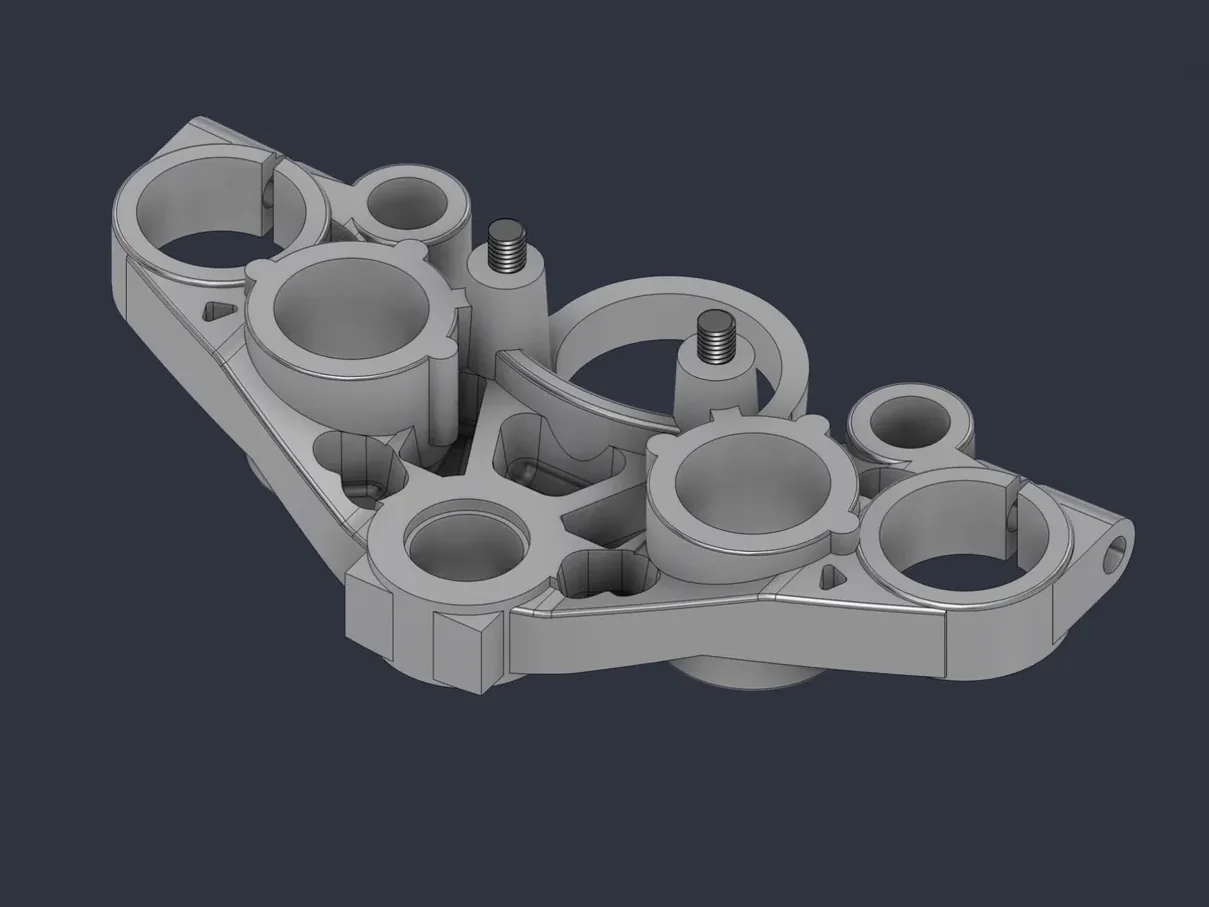
Rebuilding a cast triple clamp from a 3D scan
An Artec 3D scan of a motorcycle triple clamp, rebuilt as a parametric model in 37 sketches. Change a bore, the spacing, or the web, and the casting rebuilds around it.
Read the case study Part families
Vector drives the changing dimensions from equations, builds each size as a configuration, places them in an assembly, and exports a file for each size.
Vector mates each joint to the part that drives it, sweeps the mechanism through its range, and adds limits where parts would collide.
See the exampleMate both legs to the body: hip abduction, hip flexion, and knee concentric with their output pulleys, feet fixed to the lower legs. Then sweep the hips and knees and add limit mates so nothing collides. Don’t move the body.
Both legs are mated to the body, and the body didn’t move. Each hip abduction, hip flexion, and knee joint is concentric with its output pulley and free to rotate, and the feet are locked to the lower legs. Sweeping the joints, only the hips ran into anything: the knee motor reaches the front of the body at −144° of flexion and the hip abduction housing at 94°. I added limit angle mates of −140° to 90° on both hips, which leaves 4° at each end. The knees clear everything from −60° to 180°, so they don’t need a limit. Interference Detection at both limits finds nothing across the 345 components.
Vector reads dimensions and materials from the model, runs gear, shaft, and bearing checks in Python, and tells you which parts won’t hold.
See the exampleWe’re swapping the NEMA 23 for a 400 W servo: 1.27 N·m rated, 3.8 N·m peak, 3,000 rpm. Check the gears, shafts, keys, and bearings in the reducer and tell me what has to change.
Two parts don’t survive the servo’s 3.8 N·m peak. The brass 42-tooth gear reaches 292 MPa of contact stress against a 300 MPa allowable, a safety factor of 1.03, so I changed it to C45. Contact stress is now 363 MPa with a safety factor of 1.71, and bending is at 4.98. The bigger problem is the output shaft: its Ø10 end sees 130 MPa in torsion at peak, and with the keyway the fatigue safety factor is 0.58, so it would fail in service. Growing that end to Ø16 with a 5 × 5 key brings it to 2.4, but it changes the coupling bore, so I’ve left it for you to approve. Everything else has margin. The intermediate shaft’s fatigue safety factor is 3.9, and the bearings’ L10 life at rated torque is over a million hours.
Purchased parts with their part numbers, made parts listed separately, fasteners grouped by size, and quantities for the build you’re planning.
See the exampleMake a bill of materials for the biped. Separate purchased parts from what we print or machine, group the fasteners by size, use real part numbers where the model has them, and export a spreadsheet for two robots.
The BOM has 56 rows for the 345 components. Fifteen are purchased parts with the part numbers from the model, including six T-Motor Antigravity 4004 motors, six AEDT-9810 encoders, four bearing sizes, two AT3 belt lengths, and a MicroStrain 3DM-CX5-25 IMU. Twenty-three are printed or machined: the leg structures, pulleys, body plates, and electronics boards. The fasteners are grouped into 18 sizes, 169 pieces per robot. The spreadsheet doubles every quantity for two robots, which comes to 12 motors, 24 belts, and 338 fasteners.
An Artec 3D scan of a motorcycle triple clamp, rebuilt as a parametric model in 37 sketches. Change a bore, the spacing, or the web, and the casting rebuilds around it.
Read the case study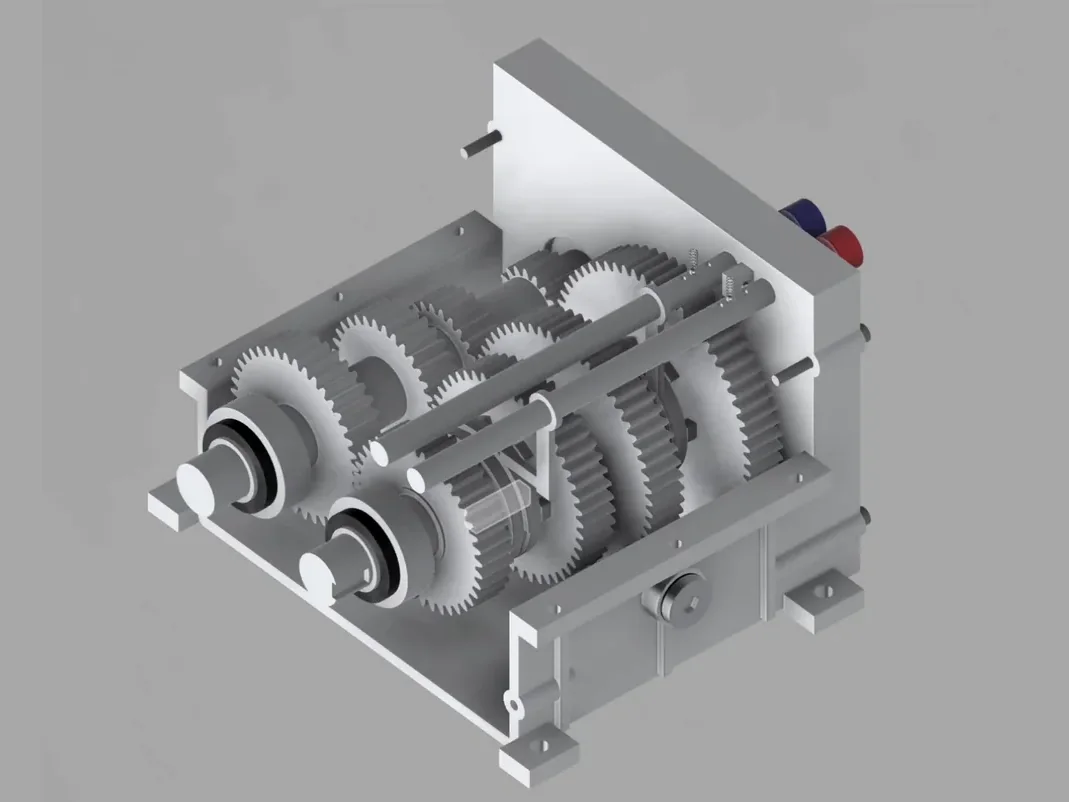
A four-speed gearbox designed from a written brief: 93 solids, with all four ratios measured from the assembly in motion.
Read the case study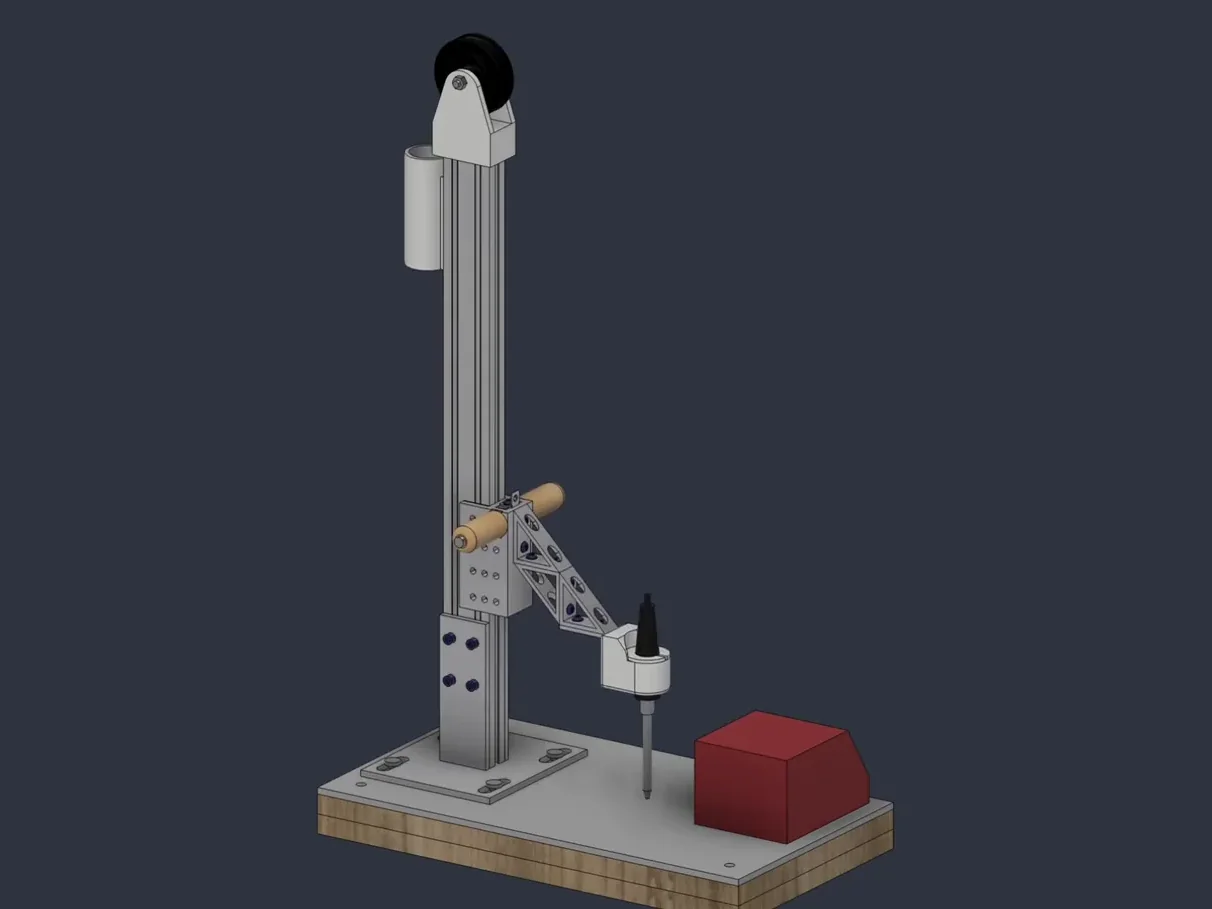
NASA HUNCH’s heat-stake press, modeled from its published drawing set: eleven custom parts, catalog hardware, and a working mechanism, checked against the sheets.
Read the case studyVector builds with sketches, features, mates, and parameters, so anyone on your team can open the model and keep working on it by hand.
It connects to the installation on your workstation. There’s nothing to migrate, and your files stay in the formats you use today.
Each step shows up in the conversation with what it changed, so you can follow the work and check it afterward.
Ask for a check and Vector measures the model: clearances, gear ratios, drawing callouts, and exported files.
We agree on the acceptance checks with your team before any work starts.
Vector runs on Windows and works with Autodesk Fusion, SOLIDWORKS, and Bambu Studio.